
Get started
Core concepts
How projects, data sources, agents, skills, and permissions relate.
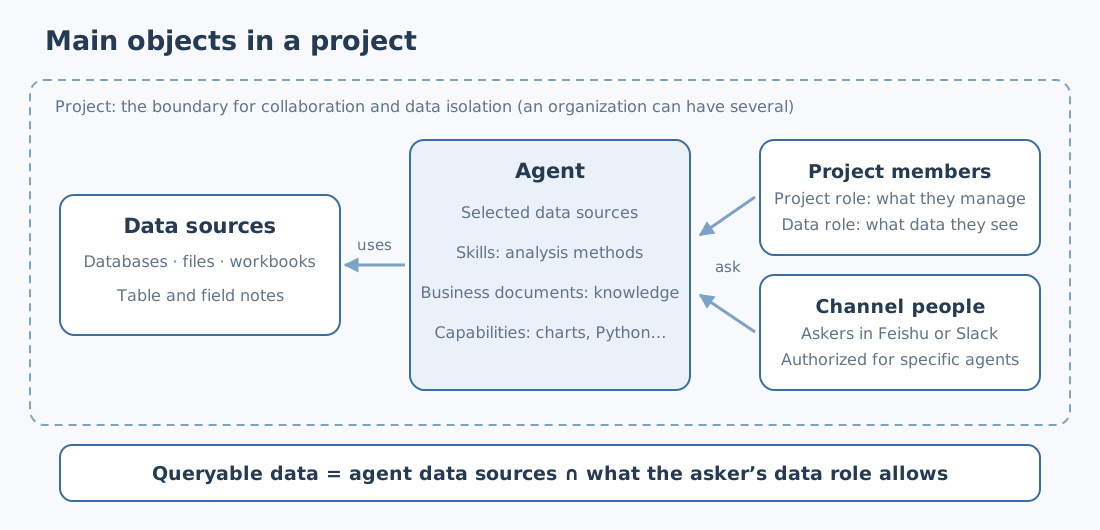
In AskTable, members ask questions about data sources through an agent. The agent determines which data can be queried and how it is analyzed; the asker's data role determines which of that data is visible to them.
Organizations and projects
- An organization is the unit for billing and administration and can have several projects. Organization members, enterprise sign-in, and plans are managed in the organization. See Organizations and projects.
- A project is the boundary for collaboration and data isolation. Data sources, agents, skills, permissions, and conversations all belong to a project, and projects cannot see each other's content.
Data
- A data source is a database connected to the project, an uploaded file, or a workbook. After connection, the system reads the structure of tables and fields (metadata). See Connect data sources.
- Table and field notes describe the business meaning of tables and fields and are the main basis for the agent to understand data. See Table and field notes.
Agents
An agent is a configured question-answering assistant made up of:
| Part | Purpose |
|---|---|
| Data sources | The data the agent can query |
| Skills | Reusable analysis methods, such as attribution analysis or a weekly report format |
| Business documents | Business rules and terms, such as metric definitions |
| Capabilities | Whether it can draw charts, run Python, ask users for clarification, search the web, and so on |
Members can create their own agents and share them with specific colleagues or the entire project. Sharing grants use only, not access to the internal configuration. See Create and configure agents.
People and permissions
A project has two independent kinds of permission:
| Project role | Data role | |
|---|---|---|
| Determines | Which features one can manage | Which data one can query |
| Values | Project owner, project administrator, project member | Created by administrators, such as “East China sales” |
| Composition | Fixed | Combines one or more policies, which define visible databases, tables, fields, and rows |
The data a question can actually reach is the intersection of the agent's data sources and what the asker's data role allows. Creating an agent or receiving a shared one never expands your data scope. See Permissions and data scope.
Askers in channels such as Feishu and Slack do not necessarily have AskTable accounts. They are recorded in the project as people profiles, and administrators authorize them to use specific agents. See Feishu channel user permissions.
Working with results
| Name | Description |
|---|---|
| Conversation | Ask and answer, with follow-up questions. See Conversations |
| Data table | A saved query that can be refreshed. See Save, download, and share |
| Dashboard | A board made of several data tables. See Dashboards |
| Analysis canvas | Multi-step analysis that keeps intermediate results. See Analysis canvas |
| Automation | Scheduled reports and metric monitors. See Scheduled reports and Metric monitors |
Conversations and dashboards are visible only to their creators by default. Project owners and administrators can switch to “Manageable” to see all of them.
Next steps
- Ask your first question: Ask your first question
- Build an agent yourself: Build an agent from scratch